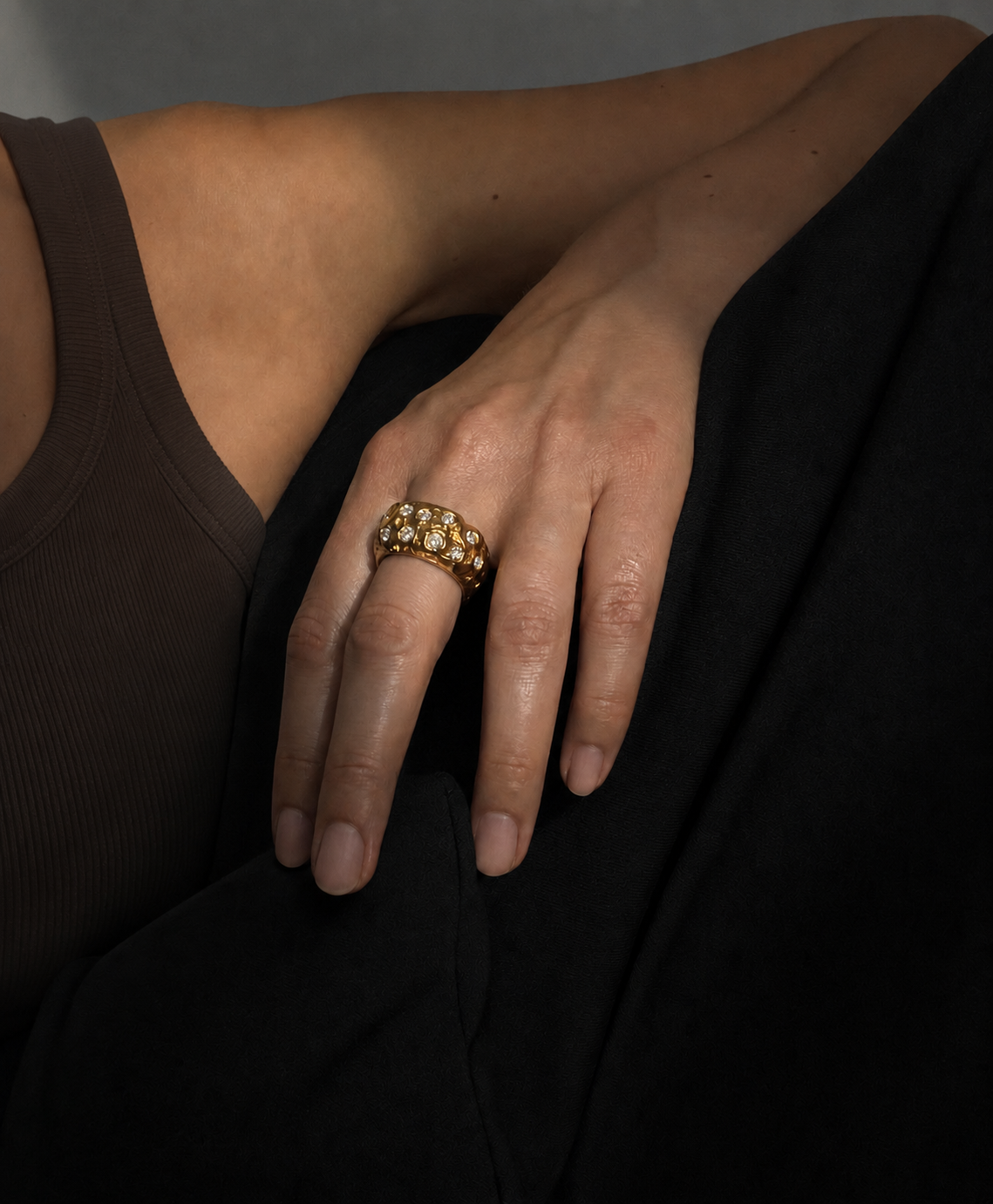
Natural or Lab-Grown diamonds? The most important thing is knowing the difference.
Are all diamonds really the same?
Over the past few years, the jewellery world has changed dramatically. Today, choosing a gemstone is no longer just about natural diamonds. We can also choose lab-grown diamonds, moissanite or cubic zirconia. With so many options available, it's easy to feel confused, especially when marketing often suggests that one choice is clearly better than another.
The truth is much simpler.
The most important thing is understanding what you're choosing.
Natural Diamond

A natural diamond begins its journey more than 140 kilometres beneath the Earth's surface, where immense pressure and extreme heat slowly transform carbon into crystal. This process takes anywhere from one to three billion years. Only powerful volcanic eruptions bring these crystals closer to the Earth's surface, where they can eventually be discovered and mined.
Yet the journey doesn't end there.
A rough diamond looks nothing like the brilliant stone we recognise in jewellery. Each crystal is carefully examined before expert cutters decide how to shape it, balancing beauty, brilliance and value. After cutting and polishing, many high-quality diamonds are graded by gemological laboratories before finally reaching the jeweller's bench.
Sometimes the greatest value of a natural diamond isn't simply its sparkle, but the thought that this tiny crystal existed long before forests, dinosaurs or even humanity itself.
Lab-grown diamond

Let's begin with the most important fact - A lab-grown diamond is a real diamond.
It is not glass or cubic zirconia. Chemically and physically, it is the same material as a natural diamond—pure carbon arranged in the same crystal structure, with the same hardness and optical properties. Even trained gemologists require specialised equipment to reliably distinguish one from the other.
The only real difference is how they were created. One was formed by nature, the other by human technology.
How are Lab-grown diamonds made?

Lab-grown diamonds are not poured or moulded. They are grown. Today, two methods are primarily used.
HPHT (High Pressure High Temperature)
This process recreates the extreme pressure and heat found deep inside the Earth. A tiny diamond seed is placed under these conditions, allowing new carbon crystals to gradually grow around it.
CVD (Chemical Vapour Deposition)
In this method, a diamond seed is placed inside a vacuum chamber filled with carbon-rich gases. Under intense heat and plasma, carbon atoms slowly settle onto the seed, building a new diamond layer by layer.
The result is still a genuine diamond.The difference is simply that nature takes billions of years, while modern technology can achieve the same crystal growth in just a few weeks.
Why are lab-grown diamonds less expensive?
Not because they are lower quality.They are more affordable because they can be produced whenever demand requires, and manufacturing technology continues to improve.
As production increases, market prices continue to decline.
This makes lab-grown diamonds an attractive choice for those seeking larger stones at a more accessible price, while also meaning they currently retain resale value differently than many natural diamonds.
What About "Blood Diamonds"?
This is one of the most frequently discussed topics.
Conflict diamonds were a serious issue in parts of Africa during the late twentieth century.
Today, most international diamond trade follows the Kimberley Process Certification Scheme, designed to prevent conflict diamonds from entering the global market.
While the system is not without criticism, today's industry differs significantly from what it was twenty years ago.
At the same time, lab-grown diamonds are not entirely impact-free either. Their production requires sophisticated technology and significant amounts of energy.
For that reason, there is no universal answer to which option is always the more ethical or sustainable one.
Moissanite

Moissanite is not a diamond. It is an entirely different gemstone.Originally discovered inside a meteorite crater, the moissanite used in jewellery today is laboratory-created.
It is admired for its exceptional brilliance and colourful rainbow flashes.
Some people love this vibrant sparkle.
Others prefer the softer, more understated fire of a diamond.
Cubic Zirconia

One of the biggest sources of confusion is cubic zirconia.
Often shortened to CZ, cubic zirconia is a laboratory-created crystal designed to imitate the appearance of a diamond.
It offers beautiful sparkle at an affordable price, although it is softer than both diamonds and moissanite, making it more susceptible to scratches and gradual wear over time.
It is also worth noting that natural zircon is a completely different gemstone. Despite the similar name, zircon is a naturally occurring mineral that has existed for billions of years and should not be confused with cubic zirconia.
At a Glance
| Natural Diamond | Lab-Grown Diamond | Moissanite | Cubic Zirconia | |
|---|---|---|---|---|
| Origin | Nature | Laboratory | Laboratory | Laboratory |
| Composition | Carbon | Carbon | Silicon Carbide | Zirconium Dioxide |
| Hardness (Mohs) | 10 | 10 | 9.25 | 8–8.5 |
| Formation Time | 1–3 billion years | 2–8 weeks | Laboratory created | Laboratory created |
| Long-term Value | Generally more stable | More market-dependent | Lower | Lowest |
My Final Thought
After years of creating jewellery, I've learned one simple thing: There is no single "right" choice.
Some people are captivated by the extraordinary journey of a natural diamond—billions of years shaped by the Earth itself.
Others appreciate the innovation, accessibility and beauty of lab-grown diamonds.
Moissanite and cubic zirconia also have their place in jewellery, as long as we understand exactly what they are.
As a jeweller, my role isn't to tell you which stone is better. My role is to help you understand the story behind each one—so that your choice becomes not only beautiful, but truly meaningful.

Leave a comment
This site is protected by hCaptcha and the hCaptcha Privacy Policy and Terms of Service apply.